
"G-Nut/Geb" is the end-user application designed to estimate receiver position in a static, quasi-kinematic or kinematic mode. Below applications are implemented using the G-Nut core library developed at the Geodetic Obsevatory Pecny. A comparison of supported capabilities is available in the feature matrix. All applications are released under the GNU General Public Licence. Figure shows an example of Geb's real-time coordinate monitoring in a quasi-kinematic mode using IGS RTCM clock and orbit corrections.

- Geb-PP is free open source lite application aimed for the post-processing mode.
- Geb-RT is free open source lite application aimed for the real-time processing mode.
DOWNLOAD
- the software download.
INSTALLATION
- instruction for the software installation.
EXAMPLES
- example configuration and outputs.
- Geb is an application providing enhanced capabilities while including all processing modes (RT and PP). The release is under preparation.
SUPPORT
- the current lite version is provided as a beta release and still undergoes final consolidations of the core library. The software is provided "as is" and without warranty of any kind. The support is given on a best-effort basis only. However, if you find G-Nut/Geb application(s) useful for your work, consider supporting its further development by ordering the enhanced version and we will try to give you a priority in the support.
Other related questions could be sent to
References
-
Vaclavovic P, Dousa J, Gyori G (2013), G-Nut software library - state of development and first results, Acta Geodynamica at Geomaterialia, pp 431-436, Vol. 10, No. 4 (172), doi:10.13168/AGG.2013.0042. PDF (or, alternatively, here).
News - in order to keep informed about news you can join the G-Nut mailing list
- 2013-03-10 - Release of Beta 0.9.0 version of G-Nut/Geb lite application.
"G-Nut/Tefnut" is the end-user application designed to estimate tropospheric path delays in various processing modes. Below applications are implemented using the G-Nut core library developed at the Geodetic Obsevatory Pecny. A comparison of supported capabilities is available in the feature matrix. All applications are released under the GNU General Public Licence.
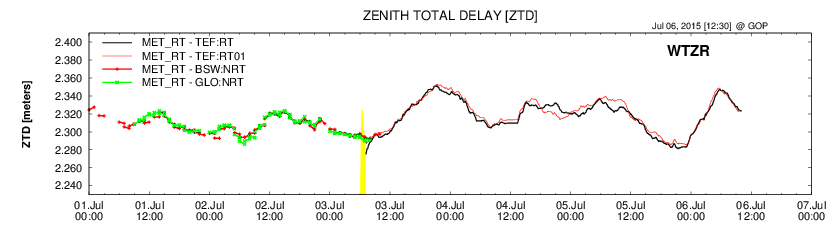
Figure shows an example of Tefnut's real-time troposphere monitoring in real-time mode using IGS RTCM clock and orbit corrections.
- Tefnut-PP is free open source lite application aimed for the post-processing mode.
- Tefnut-RT is free open source lite application aimed for the real-time processing mode.
DOWNLOAD
- the software download.
INSTALLATION
- instruction for the installation.
- Tefnut is non-free application providing enhanced capabilities while including all processing modes (RT, NRT and PP), improved models and more flexible use.
The release is under preparation.
SUPPORT
- the current lite version is provided as a beta release and still undergoes final consolidations of the core library. The software is provided "as is" and without warranty of any kind. The support is given on a best-effort basis only. However, if you find G-Nut/Tefnut application(s) useful for your work, consider supporting its further development by ordering the enhanced version and we will try to give you a priority in the support.
Other related questions could be sent to
References
- Dousa J, Vaclavovic P (2014) Real-time zenith tropospheric delays in support of numerical weather prediction applications. Advances in Space Research (2014), Vol 53, No 9, pp 1347-1358, doi:10.1016/j.asr.2014.02.021, PDF.
- Dousa J and Vaclavovic P (2013), Real-time ZTD estimates base on Precise Point Positioning and IGS real-time orbit and clock products, In: 4th International Colloquium Scientific and Fundamental Aspects of the Galileo Programme, 4-6 December 2013, Prague, Czech Republic. PDF.
- Vaclavovic P, Dousa J, Gyori G (2013), G-Nut software library - state of development and first results, Acta Geodynamica at Geomaterialia, pp 431-436, Vol. 10, No. 4 (172), doi:10.13168/AGG.2013.0042. PDF (or, alternatively, here).
News - in order to keep informed about news you can join the G-Nut mailing list.
- 2013-03-10 - Release of Beta 0.9.0 version of G-Nut/Tefnut lite application.
G-Nut/Anubis application
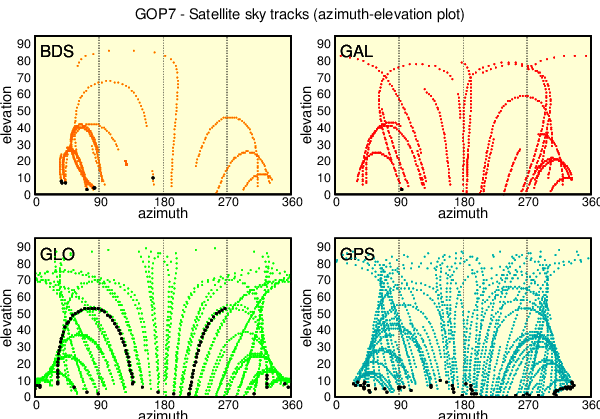
G-Nut/Anubis is a command-line tool for a quality check of modern data from all available GNSS constellations providing full quantitative and qualitative control with support of GNSS navigation messages:
- observation statistics (counts of observations, signals, bands, satellites of GPS, GLONASS, Galileo, BeiDou, SBAS, QZSS, IRNSS)
- standard point positioning (if data and navigation messages provided for GPS, GLONASS, Galileo and BeiDou)
- pre-processing including clock-jumps and cycle-slip detection and other interruptions over all constellations, frequencies and signals
- satellite elevations and azimuths (if supported with constellation-specific navigation messages)
- elevation-specific histograms, satellite ascending/descending times for horizon and user elevation cut-off
- pseudo-range multipath and noise
- carrier-phase signal-to-noise ratio
- data gaps and small data pieces
- outputs in specific XTR and minimalistic standard XML formats
- other useful lists and statistics (satellite navigation data availability, satellite healthy status etc.)
The application is implemented exploiting the G-Nut core library developed originally at Geodetic Observatory Pecny (Václavovic and Douša, 2016). Since January 2018, it has been further maintained and developed by the G-Nut Software s.r.o. company which is a spin-off of the RIGTC/GOP. G-Nut/Anubis (free) provides a free application for the RINEX file qualitative and quantitative monitoring. It is released under GNU GPL. The G-Nut Software s.r.o. provides additionally Anubis Extra and Anubis Real-Time (RT) advanced commercial versions.
The software is provided "AS IS", without warranty of any kind and a support is given on a best-effort basis only.
Questions could be sent to
G-Nut/Anubis download (new: registration required)
GOP's Multi-GNSS BRDC files (new: doi:10.24414/c4ba-kf16)
REFERENCES
- Vaclavovic P, Dousa J (2016), G-Nut/Anubis - open-source tool for multi-GNSS data monitoring, In: IAG Symposia Series, Springer, Vol. 143, pp. 775-782, doi:10.1007/1345_2015_157, PDF.
- Václavovic P., Douša J..: Development Towards Advanced GNSS Data Quality Monitoring, In: Družicové metody v geodézii a katastru, Sborník referátů. Brno, ECON publishing, s.r.o, pp 76-81, 2015 (in english PDF)
- Vaclavovic P and Dousa J (2013), Anubis – a tool for quality check of multi-GNSS observation and navigation data In: 4th International Colloquium Scientific and Fundamental Aspects of the Galileo Programme, 4-6 December 2013, Prague, Czech Republic. PDF.
- 2020-07-18 - Released Anubis 2.3 - RINEX 3.04 support incl. BeiDou 3, newly distributed here
- 2018-08-01 - Released Anubis 2.2 - improved functionality including various handling of satellite health
- 2017-11-29 - Released Anubis 2.1 - version with major updates for supporting EPOS
- 2016-10-05 - Released Anubis 2.0 - teqc total summary, expt/have at elev cut-off, preliminary XML output and IRNSS & RINEX3.03, etc.
- 2016-01-27 - Released Anubis 1.4 - SNR support, SP3 format, Windows support, kinematic and high-rate processing
- 2015-01-28 - Released Anubis 1.3 - all-constellations/-bands/-signal pre-processing, advanced statistics, merged navigation messages etc.
- 2014-08-13 - Released Anubis 1.2 - navigation messages for all GNSS constellations, GPS, GLONASS, Galileo, BeiDou standard positioning
- 2014-04-29 - Released Anubis 1.1 - qualitative QC for GPS&GLO, bancroft positioning, boost-independent version, RINEX3.02 support
- 2013-08-16 - Released Anubis 1.0 - multi-path detection for all constellations, signals and frequencies
- 2013-03-10 - Released Anubis 0.9 - beta version
"G-Nut/Shu" is the end-user application designed to process Numerical Weather Model (NWM) data field in support of tropospheric augmentation corrections for GNSS positioning, navigation and timing. The application is implemented using the G-Nut core library developed at the Geodetic Obsevatory Pecny.
G-Nut/Shu is the application for tropospheric and meteorology parameter derivation from the numerical
weather (NWM) data field. The software is designed to support a flexible functionality
(questions related to the software could be sent to
- handle NWM products: ERA, WRF, ALADIN, HARMONIE, GFS (GRIB/NETCDF), parameters, coordinate systems, etc.,
- calculate selected tropospheric and meteorological parameters for requested area (grid) or user location (GNSS stations),
- support variants of temporal and spatial interpolation methods (linear/bi-linear/spline, vert2hor/hor2ver/integration {\ldots}),
- apply different approaches for vertical parameter fitting (power/logarithmic, height-/pressure-dependent, {\ldots}),
- use various ZWD surface calculations (integration, Askne-Nordius, GOP-ZWD/GOP-AN model variants,{\ldots}),
- exploit variants of ZWD vertical scaling (GOP, RTCA-MOPS, {\ldots}),
- model height-pressure relation using fixed/linear/zero T lapse rates,
- refractivity coefficients (SW 1953, TH 1974, BV 1992, FO 1999, RU 2002),
- densify original profile with a multiplication factor,
- adjust surface parameters in vertical parameter approximations,
- estimate tropospheric linear horizontal gradients from ZWD/ZHD grids,
- estimate combination ratio between water vapour and ZWD decays.
References
- Dousa J, Elias M (2014) An improved model for calculating tropospheric wet delay, Geophys. Res. Lett., 41, 4389–4397, doi:10.1002/2014GL060271.
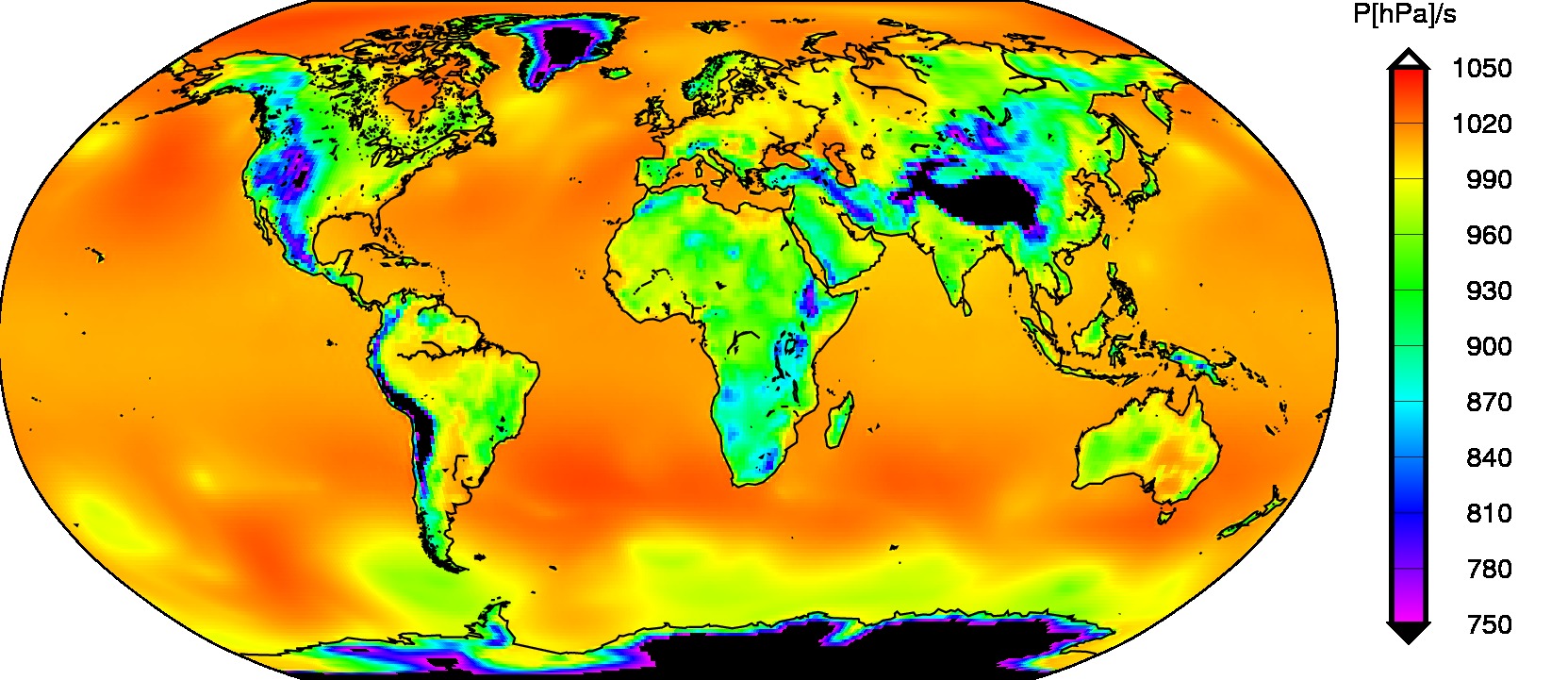
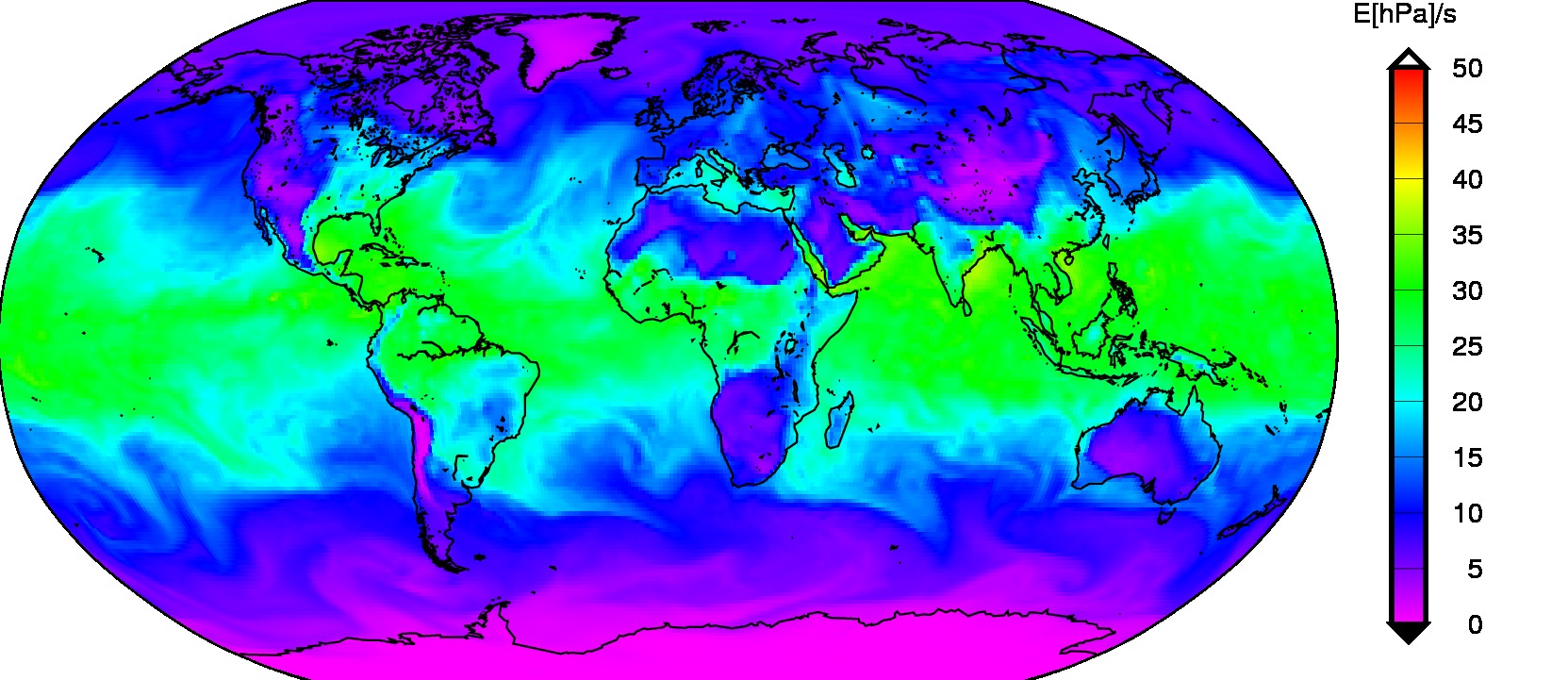
Figures show selected parameters - pressure, partial water vapour pressure, zenith total and zenith wet delays - derived from the global NWM data fields in support
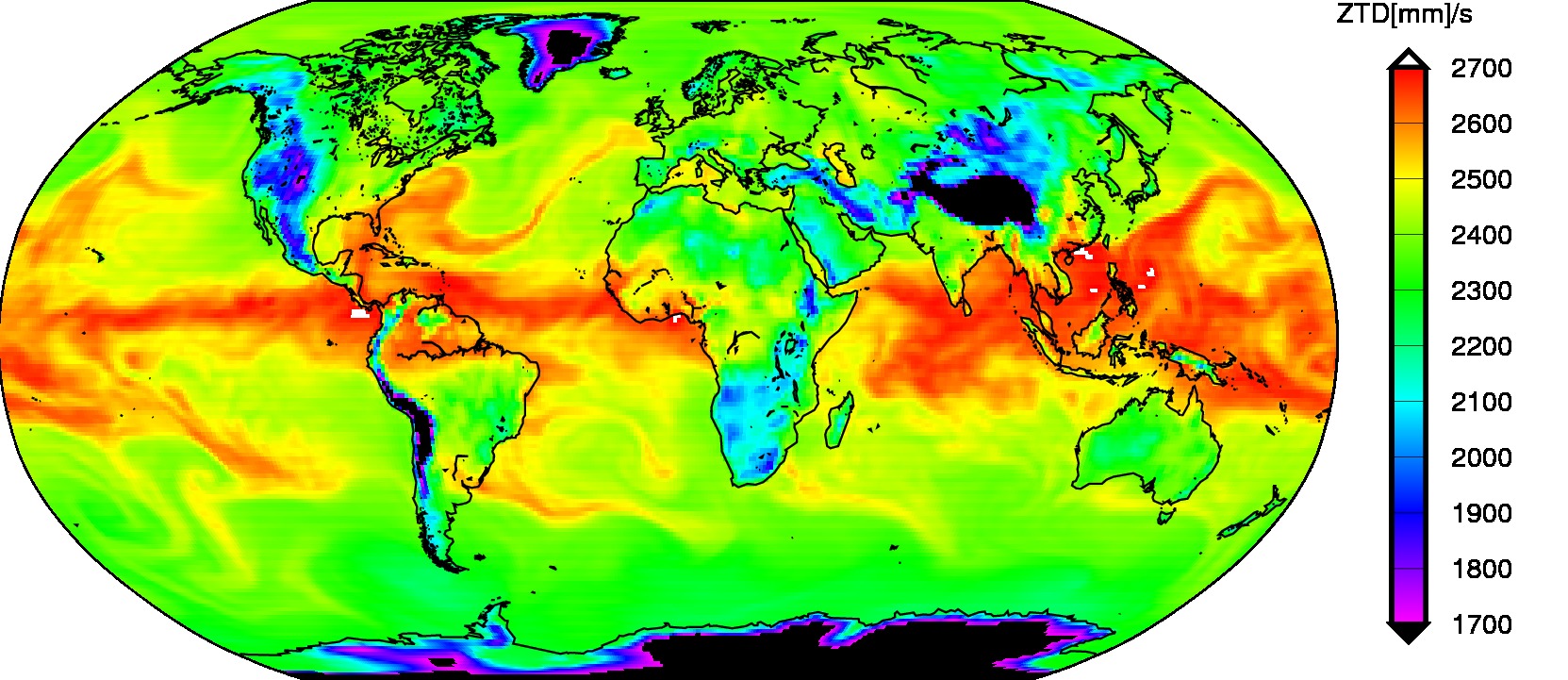
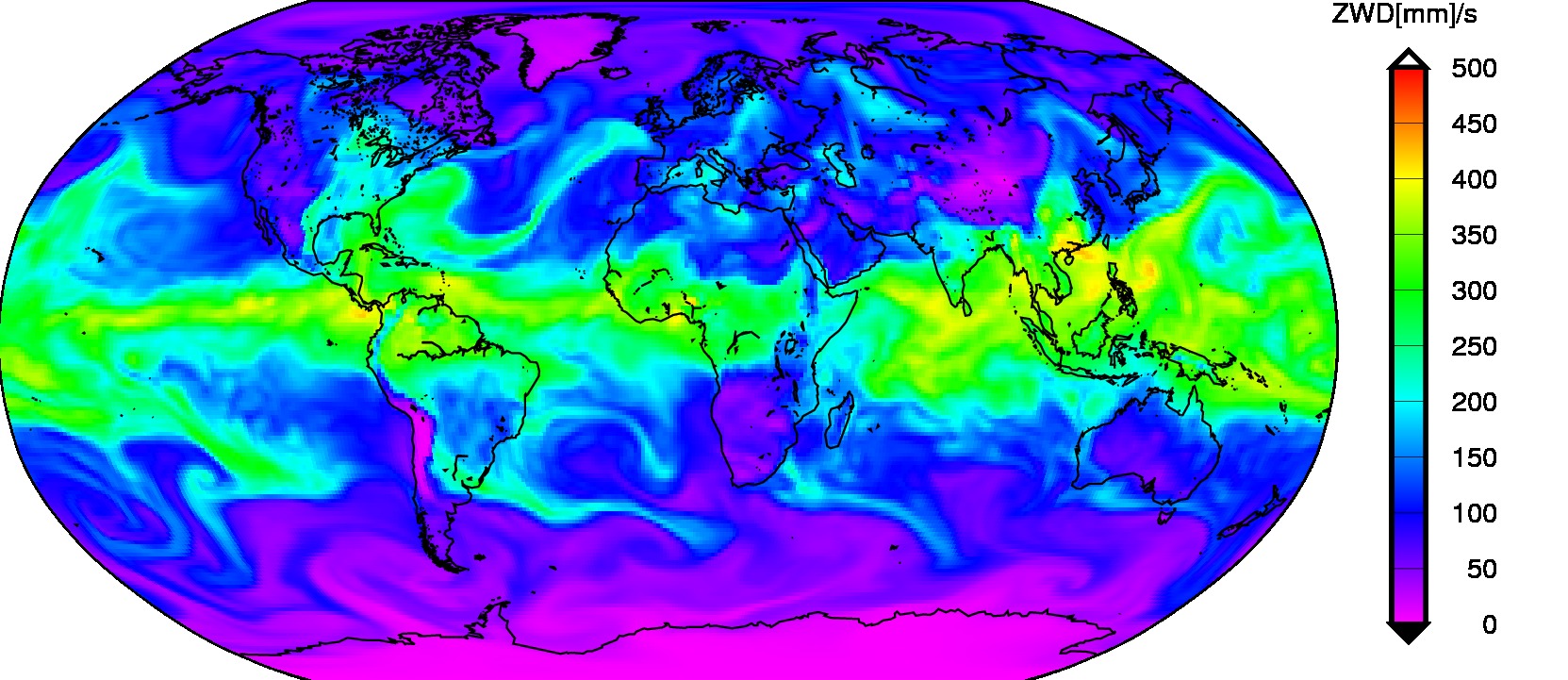
"G-Nut/Apep" is the end-user application designed to analyse parameter time-series derived from positioning (coordinates), atmosphere monitoring (tropospheric zenith path delays) or other parameters (e.g. meteorologic). The application is implemented using the G-Nut core library developed at the Geodetic Obsevatory Pecny. The application will be released under the GNU General Public Licence.
- G-Nut/Apep is the application for time-series analysis. The application is still under development.
Related questions could be sent to
News - in order to keep informed about news you can join the G-Nut mailing list.